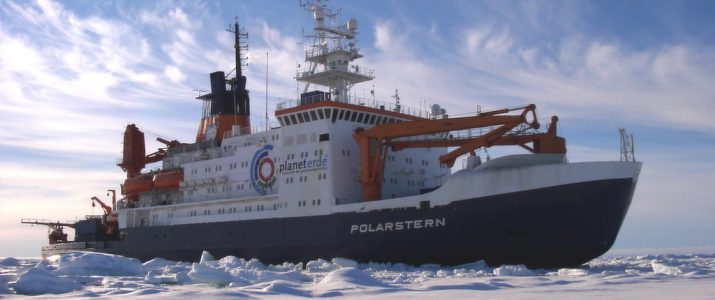
The German research vessel "Polarstern" is an important instrument of the German polar and marine research. The ship has an own data centre, a complex IT infrastructure and hundreds of scientific sensors which were maintained and supervised by seagoing FIELAX personnel throughout the years 2002 to 2013.
Author: FIELAX GmbH
PushHeat
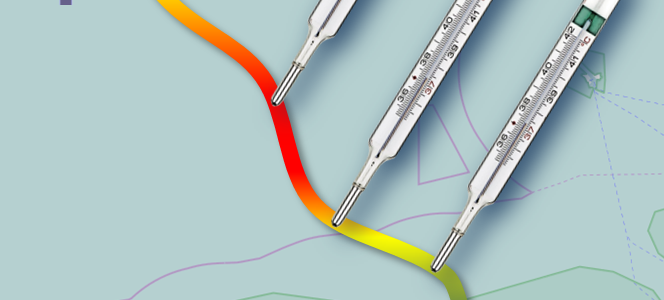
In 2012, FIELAX adapted its well-established Heat Flow measuring system to a VKG6 type Vibrocorer in order to measure thermal gradient and conductivity measurements in shear resistant marine sediments. The combined system has been successfully operated on many cable route surveys for the connection of Offshore Windparks to the main land.In cooperation with Marine Sampling Holland, FIELAX has further developed the system to work with a CPT unit used for in-situ geotechnical measurements, in order to overcome possible liquefaction, which may occur in very sandy sediments due to the vibrocoring. Therefore the sensorstring was adapted to fit into a standard coiled CPT-tube of 6 m length i.e. the number of temperature sensors was reduced to 13 temperature sensors at a spacing of 42 cm.A first successful test of this new system was carried out together with Marine Sampling Holland (see also http://www.marinesamplingholland.nl) this September in a geotechnical survey in the North Sea.
FIELAX and Laeisz separate
On the 7th of May, the remaining owners acquired the shares in FIELAX from the shipping company F. Laisz G.m.b.H.. FIELAX is thus no longer a member of the Laeisz-group and Mr. R. Pallutz and Mr. J. Fischer left the directorate. New member of the company management is Mr. Sebastian Albrecht.
“Very good” bachelor thesis
We congratulate our employee Heiner Baumgarten who successfully finished his bachelor thesis in our company with a “Very good”. The topic was the optimization of a variable bouyancy system for ROV.
Anode mass calculator for Weserwind
By order of WeserWind GmbH Offshore Construction Georgsmarienhütte we developed a web-based intranet application to calculate anode masses for offshore constructions. Sacrificial anodes are used to protect offshore steel constructions from corrosion. Our application calculated the required amount of anode masses to protect a given metal area with given coating for a given lifetime on basis of several corrosion protection norms.