Our (from now on) exclusive representative in China 青岛国科 (QDGK, Qingdao GuoKe) and us had a great show last week in 青岛 (Qingdao, China). We built new business contacts, developed new ideas and brought a lot of positive impressions. Read more
Author: FIELAX GmbH
Meet us a OI China 2017 in Qingdao!
Link to OI China official website
We kindly invite you to visit us at Oceanology China, Asia's largest exhibition for marine technology, in Qingdao (China) from 1st to 3rd November 2017. Visit our booth F41 and learn about our geothermal heat flow services, temperature models and instruments!
FIELAX's attendance at the OI is financially supported by the EFRE (European Fund for Regional Development).
Where have you been, Polarstern?
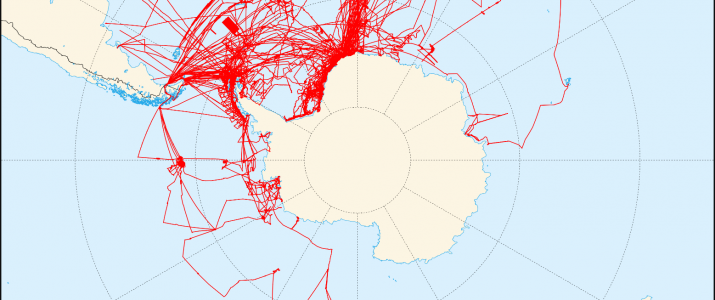
FIELAX/AWI give an answer in a recently published article in Hydrographische Nachrichten (Hydrographic News). It is about 35 years of navigation data history of the German research ice breaker RV "Polarstern". Read more
World Premiere: HeatFlow measurements at great depths (10.000m)
10.000m equates to 1000bar - that's quite a lot.
The mean depth of the world ocean is 'only' about 3.700m but the great deep sea plains are below that and the tectonic trenches often reach water depths well in the 7-8-thousand meter range. However, so far only 12 locations are known where the ocean depth exceeds 10.000m from which the deepest is the so-called Vityaz Deep (a part of the Challenger Deep, cf. https://en.wikipedia.org/wiki/Challenger_Deep).
We proudly announce that we have managed to modify our well-established measuring system to resist 1000bar of outer pressure and herewith present the new model HeatFlowProbe UD (UD for Ultra Deep).You are invited to find out about heat flow in the greatest depths ofthe ocean (as long as your wire is long enough...).
Data collection framework for Research & Science
The Alfred Wegener Institute (AWI) is a pioneer in digitalisation of research data acquisition processes. They use a FIELAX data collection framework to automatically collect data from various research platforms worldwide such as drift buoys in the Arctic, satellite base stations or moving vessels. The framework continuously collects so called "near real time" (NRT) data via protocols like FTP, SMB or IMAP. Regular expressions and filters help to specify only a subset of data files / emails to be downloaded. Post-processing scripts can be automatically triggered after a successful download. Read more